Todays session we explored a new product and researched into a reactable table as it offeres a different visual view point and perspective to produce music
· The reactable table is an interactive surface, which has introduced a revolutionary way to create music in the digital form.
· Blocks are placed on surface to produce loops, delays, pitch modulation, oscillation and other electronic filters and rhythmic patterns.
· The idea of the technology is to be able to visually create music, as well as using your fingers to create electronic music as opposed to using editing software.
· Creates a very immersive experience for the user, and can be suited to many musical styles, allowing users’ who have no musical knowledge to experiment and create.
· Has now been brought to iPhone and Android devices, enabling a cheaper version to all users of new generation phones.
AUGMENTED REALITY

A technology that superimposes a computer-generated image on a user's view of the real world, thus providing a composite view
AUGMENTED REALITY
Learn about Augmented Reality (do some research) and reflect on the findings in your blog
• Produce an AR installation (similar to the Chair demo) using Junaio Creator and image recognition technology (Junaio GLUE)
• Present your results to others, put some smartphone screenshots on your blog and analyse/evaluate your results
• Produce an AR installation (similar to the Chair demo) using Junaio Creator and image recognition technology (Junaio GLUE)
• Present your results to others, put some smartphone screenshots on your blog and analyse/evaluate your results
Your final product will not be marked (your entire blog will be marked by Gianni)
• Since we have no time for 3D modelling, feel free to use any software (3ds Max, etc) to create your 3D object and then Blender to convert into the md2 format
• Also, you may use a 3D object from a library of 3D objects (but remember © , royalty free, references etc)
• Since we have no time for 3D modelling, feel free to use any software (3ds Max, etc) to create your 3D object and then Blender to convert into the md2 format
• Also, you may use a 3D object from a library of 3D objects (but remember © , royalty free, references etc)
Try to be creative and develop something cool, funny, to be proud of ...
• Note that any image can be a tracking image (your photo, Coca-Cola logo etc)
• A clever integration of your training image and your 3D AR object is the key to the success.
• Note that any image can be a tracking image (your photo, Coca-Cola logo etc)
• A clever integration of your training image and your 3D AR object is the key to the success.

What Is augmented Reality
- Augmented reality (AR) is a term for a live direct or indirect view of a physical real-world environment whose elements are augmented by virtual computer-generated imagery.
- The idea that an observer's experience of an environment can be augmented with computer generated information. Usually this refers to a system in which computer graphics are overlaid onto a live video picture or projected onto a transparent screen as in a head-up display.
- An interactive 3D environment that blends with our physical reality; the capability to link the virtual world with the physical world through for example a “superman vision” where a video image is superimposed with a 3D model of the same environment and adding hidden information ...
- Links the virtual and real world through computer generated elements such as sound, video or image. Largely accessed via smart phones the Augmented Reality games or applications make elements of your physical location interactive in real time.
- Reality with technological enhancements. Applications, such as Layar, provide additional information about your environment using your mobile phone camera. Online AR games are also based in the real world and are often in real time.
Uses of Augmented Reality
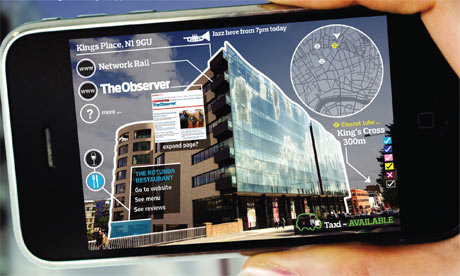
AR/Augmented Reality is widely used from day to day from gaming, the places we work, a game of football to even walking down the street. Games have taken of on smart phones, Andriod/Iphone and quite alot now include taking the real world and adding a virtual world layer over the top. Games such as Sky Siege show this in which the background of the game is displayed via the smart phones camera on the screen, then the game itself is overlayed on top. In this case it takes the sky as the background image and then over layers virtual helicopters in which you have to aim your phone around in the sky trying to hit them with rockets as they virtual move around the enviroment.

In the sense of walking down the street. AR can imbed the very enviroment your walking into a virtual world filled with information or even alter the place in which you occupy. For example the following video shows how the buildings can change on personal prefence. Another example an information app that will use the smart phones camera to in real time scan the evniroment and then assoicate certain virtual overlays to buildings displaying information such as a shop name and there opening hours. Or maybe which taxi is free or how could a certain resturant is on food/drink or atmosphere.
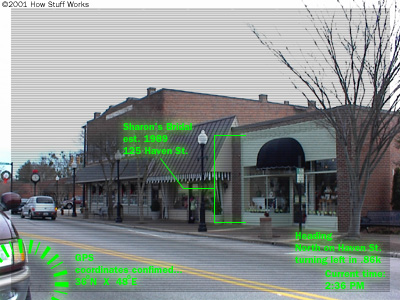
With Smart Phones becoming so common there are thousands of applications avaialbe to use such as guides, information kiosks. Each with a seprate purpose such as locating nearby restruants or taxi's. Some even offering directions and distant to the object. For examples heres one to help you find you car, this can be found on the iPhone Applications store
Augmented Car Finder: a fun car finder that takes advantage of augmented reality technology to show you where you have parked your car. It’s not perfect but one of the better ones on the market.

In a workplace sense, AR is displayed on how it can be useful in this video below. Product can be found on the andriod marketplace for download on smart phones. The app works by direct user input in sharing comfortable working places. The say that work is not just a place we go to, its more on the move now as it becomes our lives and they use this idea as a forfront for there app.
Another AR app that implements a facebook idea using the camera on a smartphone to scan a person face then will display a virtual web arround the of there information like a profile page as such.
AUGMENTED REALITY ARTISTS
http://bernaekim.wordpress.com/2011/03/14/creativity-bytes-a-brief-guide-to-augmented-reality-art-exhibits/
G George
I looked into this artist because he adds another layer to Street Art using Augmented reality. in the same way a person would graffit over an object to give it new meaning, He does the same but with AR instead. So an object would appear as normal till using a smart phone app to view the object through teh camera will give the object a new layer.
"G George is an example of street ARt inside a gallery. In Lab Art, a Los Angeles gallery, when placing street artist Kai Aspire's "Masked" (George Washington) in the camera view of your smartphone (Android or Iphone), the painting unlocks a piece of augmented reality art, or ARt. This kind of augmented reality | artistic interaction is an example of hypAR-reality, which implodes the distinction between the "real" and the "imaginary." Triggered from the "real" world, the virtual "art" can reveal another layer of meaning, which is in this case... the "g"angster street artist we always knew G George was."
I really like this idea of adding personal touchs to world. Taking reality and adding your own virtual reality for people to discover.
Where did it come from?
The use of augmented reality in exhibition spaces is an emerging field, just beginning to take form and experiencing an experimental sandbox phase. AR artist Helen Papagiannis merges old techniques with new as she commingles the real with the virtual.
While artist Pablo Valbuena has been layering projected realities onto objects with his Augmented Sculpture series since 2007.
And then there’s the virtual reality hackers like global cyberartist group Manifest.AR whose members arranged the DIY AR invasion of MoMA last year—their hijacking of the physical realm via virtual technologies may seem entirely newfangled, but they have lineage with cross-disciplinary art groups like Neo-Dadaists Fluxus.
‘AR’ technology allows anyone to (re-)shape anything, anywhere!
IDEA
I would like to uses Augmented Reality to build a graffit playground using the smartphone. For example you could walk down a street and make your own virtual graffiti that will then save to phones data in which anyone with the app could walk down the same street and use the camera of there phone to get an virtual overlay of the street display there artworks as well as your own graffiti art works. If i had the knowledge and know how i would like to persue this idea but to due to time contstraints id like to make a more fun simplefied version. My would be to make a social database in which using a smart phone you could scan a friends face to the database which will be stored by facial recongisation. But my twist would be to then take this facial recongisation and use a image overlay over the persons face, such as an image that resembles there personality or maybe a cartoonised face to show a virtual world 2nd persona of them.


No comments:
Post a Comment